SAT Math Formula Set: Understand Correctly, Remember Clearly, Use Quickly
In SAT Math, formulas are only truly useful when you know when to use them, how to use them, and what pitfalls to avoid.
This article summarizes the most important formula groups, along with thinking strategies to apply quickly in digital SAT.
To do well on SAT Math, you need 3 things
1
Master key formula groups, don't learn scattered information.
2
Understand the essence and conditions for application, not just memorize.
3
Practice choosing the right formula very quickly for each question type.
The SAT Math formula set is not just a list to memorize. With today's SAT,
you need to understand formulas according to the test's logic: which formulas appear frequently, which are provided in the reference sheet,
which you should remember to save time, and most importantly, how to use them flexibly in real question contexts.
When learned correctly, formulas will help you reduce processing time, decrease calculation errors, and feel more confident on difficult questions.
Understanding and Applying the SAT Math Formula Set
The difference between learning math normally and doing SAT Math lies in decision-making speed. Many students know formulas but still lose points
because they don't recognize question types, use wrong information, or take too long to work through. Therefore, learning formulas in SAT must include three steps:
identifying question type, selecting the right formula, and checking application conditions.
Don't just learn by "seeing a formula and copying it." Train yourself this way: look at the problem, ask yourself if it's geometry, algebra,
data, or probability; next determine the quantity you need to find; finally choose the appropriate formula. This is the way to learn to use formulas as a tool,
not as a mechanical burden to remember.
An effective SAT Math formula set is one you understand clearly and know how to deploy quickly for each question type.
The Most Important Formula Groups in SAT Math
G
Plane Geometry
This is a formula group that appears very frequently: area, perimeter, side length, angle, special triangles, circles.
You need to remember formulas while knowing how to read diagrams and select useful information.
πr²2πr1/2 × base × heightPythagorean
A
Algebra and Functions
This is the main focus of SAT Math. Students need to master linear equations, quadratic equations, systems of equations, expressions,
functions, graphs, and quick transformation skills to find the correct answer.
ax + b = 0ax² + bx + c = 0systems of equationsfunctions
D
Data and Probability
Questions about averages, ratios, percentages, data tables, and basic probability are becoming increasingly important.
This group requires the ability to read data and reason correctly, not just use a calculator.
meanmedianprobabilitypercent
Key Points to Remember about Current SAT
Current SAT Math is done entirely on a digital platform, and test-takers can use calculators throughout the Math section.
This doesn't mean you can skip learning formulas. Calculators help speed up calculations, but the ability to recognize mathematical patterns
and choose the right formula is what creates the difference in scores.
Basic Geometry and Solid Geometry
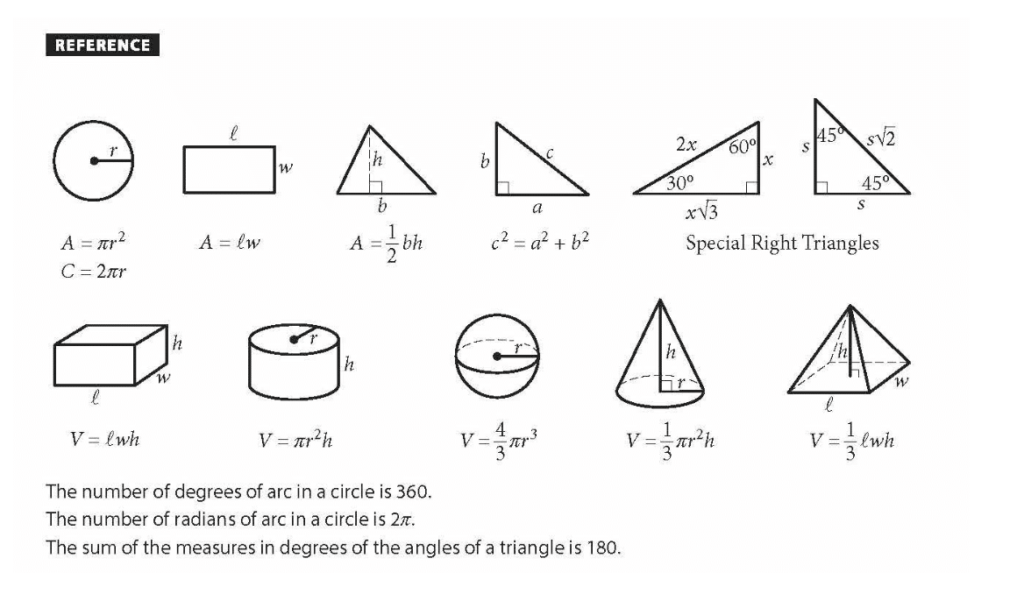
Geometry in SAT doesn't focus on lengthy proofs but on quick application. Formulas you should especially master include:
area of circle, circumference of circle, area of rectangle, area of triangle, volume of rectangular prism, volume of cylinder,
along with the Pythagorean theorem and special triangles.
Knowledge Group
Key Formula
Note When Doing SAT
Circle
Area = πr²; Circumference = 2πr
Easy to confuse radius and diameter. Always check whether the problem gives r or d.
Rectangle
Area = length × width
The problem may hide information in expressions or diagrams, not give numbers directly.
Triangle
Area = 1/2 × base × height
Height must be perpendicular to the base, not just any side.
Rectangular Prism
Volume = length × width × height
Distinguish between volume and surface area to avoid losing points unnecessarily.
Cylinder
Volume = πr²h; lateral surface area = 2πrh
Questions typically test the ability to read diagrams and correctly identify r and h.
Right Triangle
a² + b² = c²
Only applies to right triangles; c is the hypotenuse.
Special Triangles
30-60-90: 1 : √3 : 2; 45-45-90: 1 : 1 : √2
Memorizing these ratios saves much more time than solving manually.
Equations, Inequalities, and Systems of Equations
Algebra is the core part of SAT Math. You need to handle linear equations, quadratic equations, systems of equations, and inequalities well.
But more important than being able to solve is solving quickly, correctly, and avoiding unnecessary transformations.
1
Linear and Quadratic Equations
With linear equations, the goal is to isolate the variable as quickly as possible. With quadratic equations, you need to be flexible between factoring,
using the quadratic formula, or observing the graph. On the SAT, choosing the shorter solution method is often more important than applying one fixed formula to every problem.
2
Systems of Equations
Master both substitution and elimination methods. Some questions will give you equations in graph, table, or real-world context form.
You need to recognize that the essence is still finding the intersection point or values that satisfy both conditions simultaneously.
3
Inequalities
The most common mistake is forgetting to flip the inequality sign when multiplying or dividing both sides by a negative number. Additionally, many SAT questions test understanding of solution regions,
value ranges, and the meaning of solutions in context, not just asking you to solve for x.
Statistics and Basic Probability
This is an area many students underestimate, but on the SAT it frequently appears as table reading, charts, percentages,
ratios, or data comparisons. You need to both know the basic formulas and understand the meaning of each measure.
M
Mean, Median, Mode
Mean is the average, median is the middle value, and mode is the most frequently occurring value. Don't just memorize the definitions;
practice recognizing when the question asks for a "representative value" and when outliers skew the average.
S
Data Spread
On the SAT, you may encounter questions about spread, comparing two datasets, or interpreting data rather than deep calculations.
Read the question carefully to determine whether it's asking about central tendency or spread.
P
Basic Probability
Probability is usually asked in intuitive form: favorable outcomes divided by total outcomes. When dealing with combinations or permutations,
the key is clearly distinguishing whether order matters.
A More Effective Way to Learn Data
Don't just practice formulas. Practice reading tables, charts, percentage changes, ratios, and data trends.
Many SAT Math questions aren't difficult in calculation but are easy to get wrong if you misread the meaning of numbers in the chart.
Quick Formula Strategy During the Exam
Learning formulas without pairing them with test-taking strategy makes it very hard to maximize your score. For SAT Math, formulas need to come with speed and the ability to eliminate wrong answers.
1
Read the Question First, Then the Formula
Before thinking about formulas, identify what the question is asking for: length, area, solution, ratio, or probability.
This approach helps you avoid lengthy calculations that aren't necessary.
2
Prioritize the Shortest Method
Many SAT questions can be solved multiple ways. Practice recognizing when to substitute values, when to look at the answer choices, when to use a graph,
and when to use a calculator for a quick check.
3
Check the Conditions for Application
A correct formula used in the wrong context still gives the wrong answer. For example, the Pythagorean theorem only applies to right triangles; the triangle area formula needs the correct height;
probability questions need the correct sample space defined.
4
Turn Formulas into Reflex
The only way to do this is to practice many real problems. When practicing, don't just score right or wrong. Ask yourself:
where did I lose time, where did I misapply the formula, is there a faster way.
Conclusion: The SAT Math Formula Set Shows Its Power Only When You Use It Right
Remember formulas correctlyUnderstand the fundamentalsApply quicklyOptimize time
The set of math formulas on the SAT is a very powerful tool, but it cannot replace practicing reasoning and strategic problem-solving.
To truly increase your score, you need to combine three elements: solid foundational knowledge, quick problem type recognition, and flexible formula use.
Once you achieve that, SAT Math will no longer be a section to fear but a place where you can gain points.
Clever Academy supports students in building a strong SAT Math foundation, reinforcing test-taking strategies, and optimizing study plans according to actual proficiency levels.
Clever Academy
Frequently Asked Questions
Do I need to memorize all SAT Math formulas?
You don't need to memorize everything mechanically by rote. What's more important is mastering core formulas, understanding when to apply them, and practicing enough to use them quickly when you encounter the right question type.
Which formula groups are most important in SAT Math?
The most important groups typically include algebra and functions, basic geometry, the Pythagorean theorem, special triangles, data – percentages – ratios, and basic probability.
Can I use a calculator on SAT Math nowadays?
Yes. In the current SAT Math, test-takers can use a calculator throughout the entire Math section. However, the calculator only aids with computation; identifying question types and selecting the correct formula remain the deciding factors.
How can I remember SAT Math formulas longer?
The best approach is to learn formulas by question type, then apply them immediately to real practice problems. When a formula is tied to a specific situation, you'll remember it longer and know when to use it.
Is learning formulas alone enough to score high on SAT Math?
No. Scoring high on SAT Math requires a combination of foundational knowledge, reading comprehension skills, strategies for choosing the fastest solution method, time management, and consistent practice with test-standard questions.
Hi I am the Clever Academy AI assistant. Which test are you preparing for - SAT, IELTS, GMAT, GRE, CFA - or do you need U.S. study-abroad advice? Ask me anything, or leave your name & phone number for a free study plan consultation.
This chat uses the Claude AI assistant by Anthropic (United States) to reply; what you write is processed there. The details you leave (name, phone number) are used by Clever Academy to contact you. Personal Data Protection Policy
Cookie settings. We use essential cookies to make this website work. With your consent, we also use analytics cookies (Google Analytics) to count visits and advertising cookies (Meta Pixel, OpenAI Ads) to measure our ads. Nothing is loaded until you choose. Personal Data Protection Policy