
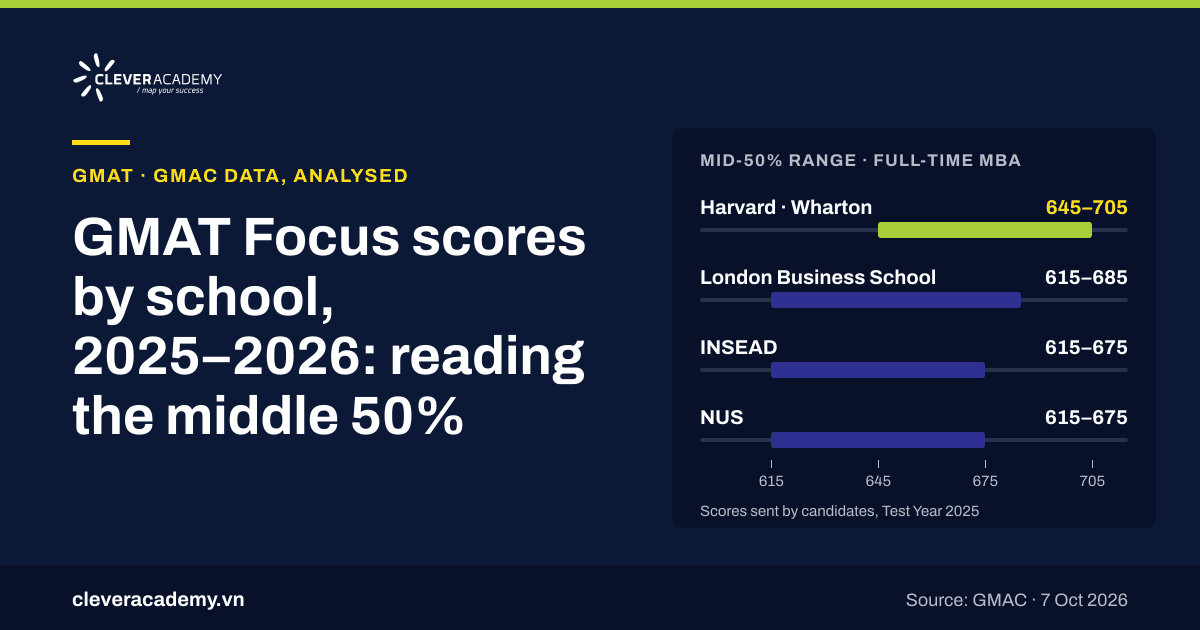
GMAC, the organisation that owns the GMAT, has released its Exam Score Guide 2025–2026. It lists the GMAT Focus Edition scores that candidates sent to more than 1,600 graduate business programmes worldwide, from Harvard, Wharton and INSEAD to NUS, HKUST and schools across India, China and Australia.
Until now, anyone asking "what score does this school need?" usually had to convert from the old 200–800 scale of the 10th Edition. This guide uses the Focus Edition's 205–805 scale directly. We read all 48 pages, and this is what matters most if you are preparing an MBA or specialised master's application.
What the guide measures, and what it doesn't
The numbers are easy to misread. Keep these five points in mind:
- These are scores candidates sent, not scores of admitted students. Each range comes from the score reports candidates chose to send to that programme. People who sent scores to Harvard include both admits and rejects.
- "Mid 50%" is the middle half. For a range of 645–705, about a quarter of the reports sent were below 645 and about a quarter were above 705.
- Only GMAT Focus Edition scores are included, for reports requested in Test Year 2025 (1 July 2024 to 30 June 2025). 10th Edition scores are not counted.
- Only programmes that received five or more score reports are listed. Some small programmes therefore show very wide ranges: Fordham's MS in Management is 555–715, and Goethe University Frankfurt's PhD in Management is 465–695. The smaller the sample, the less stable the range.
- These are not minimum scores. GMAC says so on the first page, and recommends checking each school's official website.
A quick refresher on the exam: GMAT Focus has three 45-minute sections. Quantitative Reasoning has 21 questions, Verbal Reasoning 23, and Data Insights 20. The test takes 2 hours 15 minutes, with an optional 10-minute break. Scores range from 205 to 805. You can send scores to five programmes free of charge within 48 hours of testing, and the official score report appears on mba.com within 1–3 days.
Full-time MBA at top US schools
| School | Programme | Mid 50% range |
|---|---|---|
| Harvard Business School | MBA, Full Time | 645–705 |
| Stanford GSB | MBA, Full Time | 645–705 |
| Wharton (UPenn) | MBA | 645–705 |
| Chicago Booth | MBA, Full Time | 645–705 |
| MIT* | MBA, Full Time | 645–705 |
| Kellogg (Northwestern) | MBA, Full Time (Two Year) | 645–695 |
| Columbia Business School | MBA, Full Time | 645–695 |
| Michigan Ross | MBA, Full Time | 645–695 |
| NYU Stern | MBA, Full Time | 635–695 |
| Berkeley Haas | MBA, Full Time | 635–695 |
| Dartmouth Tuck | MBA, Full Time | 635–685 |
| Duke Fuqua | The Duke MBA – Daytime | 635–685 |
| Virginia Darden | MBA, Full Time | 635–685 |
| Cornell Johnson | Cornell MBA | 635–685 |
| Carnegie Mellon Tepper | MBA, Full Time | 635–685 |
| Yale SOM | MBA, Full Time | 625–685 |
| UCLA Anderson | MBA, Full Time | 625–675 |
| UNC Kenan-Flagler | MBA, Full Time | 625–675 |
| UT Austin McCombs | Full Time MBA, Austin | 615–675 |
| Emory Goizueta | MBA, Full Time | 615–675 |
| USC Marshall | MBA, Full Time | 615–675 |
| Georgetown McDonough | MBA, Full Time | 595–655 |
* In the guide, MIT's programmes (MBA, Sloan Fellows MBA, Master of Finance, Master of Business Analytics and others) are grouped under the heading "MIT Center for Real Estate".
Three things stand out:
- The very top converges at 705. The first five schools share the same 645–705 range. At this level the GMAT stops separating candidates; work experience, essays and interviews decide.
- The gaps between tiers are smaller than you might think. From Harvard down to UCLA Anderson, the lower bound moves by only 20 points. Focus scores move in steps of 10, so that is one or two notches.
- A quarter of the scores sent to the top group were below 645. A score under the middle range is not the end of the road, but the rest of the application then has to stand out.
Europe: about 30 points lower at the bottom of the range
| School | Programme | Mid 50% range |
|---|---|---|
| London Business School | MBA, Full Time (15–21 months) | 615–685 |
| INSEAD | MBA, Full Time | 615–675 |
| HEC Paris | MBA, Full Time | 615–675 |
| Oxford Saïd | MBA, Full Time | 605–665 |
| Cambridge Judge | The Cambridge MBA | 605–665 |
| IE Business School | International MBA | 595–645 |
| ESADE | MBA, Full Time | 595–655 |
| IMD | MBA, Full Time | 585–655 |
| IESE | MBA, Full Time | 575–655 |
| Warwick Business School | MBA, Full Time | 575–645 |
| SDA Bocconi | MBA, Full Time | 565–645 |
| Mannheim Business School | Full Time/Part-Time MBA | 565–635 |
INSEAD, LBS and HEC Paris have a lower bound of 615, 30 points below the top US group. LBS's upper bound of 685 is only 20 points below Harvard's. If you score 655–665 and are weighing the US against Europe, you are already in the upper half at several of Europe's leading schools.
Asia-Pacific
| School | Programme | Mid 50% range |
|---|---|---|
| NUS Business School | The NUS MBA (Full Time) | 615–675 |
| Nanyang (NTU) | MBA, Full Time | 605–655 |
| Melbourne Business School | MBA, Full Time | 595–655 |
| CEIBS | MBA, Full Time (16 months) | 575–655 |
| SMU Lee Kong Chian | MBA, Full Time | 575–645 |
| UNSW AGSM | MBA, Full Time | 575–645 |
| University of Sydney | MBA (Leadership and Enterprise) | 575–645 |
| Hitotsubashi ICS | MBA (2-Year) | 555–645 |
| HKU – Fudan | International MBA | 555–675 |
| HKUST | Full-time MBA | 555–645 |
| Tsinghua SEM | Tsinghua Global MBA | 555–645 |
| Peking University Guanghua | Global MBA (IMBA) | 555–645 |
| CUHK Business School | MBA, Full Time | 545–645 |
NUS's lower bound of 615 matches INSEAD and LBS. Schools in Hong Kong and mainland China show wider ranges, often 90–100 points (CUHK is 545–645), so the scores of their applicants are spread widely. A candidate with 625–645 is already in the upper half at many programmes in the region.
Finance and analytics master's often sit above the MBA
This is the finding most people miss. At the same school, quantitative master's programmes often show higher ranges than the MBA.
| School | Programme | Mid 50% range |
|---|---|---|
| Princeton | Masters in Finance | 655–715 |
| MIT | Master of Finance | 655–705 |
| Cambridge Judge | MPhil in Finance | 655–690 |
| Columbia | Applied Analytics (School of Professional Studies) | 655–695 |
| MIT | Master of Business Analytics | 645–695 |
| NUS | MS in Financial Engineering | 645–695 |
| Imperial College Business School | MSc Risk Management & Financial Engineering | 645–675 |
| NUS Business School | MSc in Finance | 635–675 |
| LSE | MSc Finance (Full-time) | 625–675 |
| HKU Business School | Master of Finance | 625–675 |
| NTU Nanyang | MSc Finance Programme | 625–675 |
Some side-by-side comparisons: at Cambridge, the MBA is 605–665 while the MPhil in Finance is 655–690. At NUS, the MBA is 615–675 and the MSc in Finance is 635–675. At HKUST, the full-time MBA is 555–645 while its full-time Other Masters group is 615–665.
The reason is simple. These programmes attract strong quantitative candidates, often recent graduates with little work experience, for whom the GMAT is one of the few strong signals in the file. If you are aiming for finance or business analytics, set a target at or above the MBA target for the same school.
Master in Management (MiM) programmes for early-career candidates are not low either. HEC Paris (Grande École), London Business School and LSE all sit at 605–675, and Imperial at 605–665.
Part-time, EMBA and online: lower, but wider
At the same school, part-time programmes usually sit 10–30 points below the full-time MBA at the lower bound. Chicago Booth's Weekend MBA is 615–675, against 645–705 for the full-time MBA. NYU Stern's Langone Part-time MBA is 575–655.
Programmes for senior professionals show very wide ranges. Wharton's Global MBA for Executives spans 555–685, a 130-point band. In these programmes, management experience counts for more than the test score.
Setting your own target
Here is a four-step way to use the guide:
- List 6–8 programmes and note each one's mid-50% range. Use the exact programme, not the school as a whole: Harvard, for example, has both an MBA and doctoral programmes with different ranges.
- Use the upper bound of your most ambitious programme as your study target, and the middle of its range as "good enough to apply". If your score is below the lower bound, consider retaking, or make sure the rest of your file is strong enough to compensate.
- Cross-check with each school's class profile (median and range of admitted students). As noted above, the GMAC guide shows the scores of senders, not admits.
- Note the programme code when you send scores. Every programme has its own code in GMAC's system; Wharton's MBA, for example, is G56-97-73. Sending to the wrong programme at the same school means paying to send again.
To see what a given score means in percentile terms, read GMAT Focus Edition score chart and percentile rankings. To translate older 10th Edition scores, see GMAT Focus and GMAT Classic score conversion tables.
Where to start
How far is your current score from your target? The quickest way to find out is a diagnostic test. Try Clever Academy's free GMAT online test, or look at our GMAT preparation course, which builds a study plan around your target score and school list.
Sources
- Graduate Management Admission Council (GMAC), GMAT Exam Score Guide 2025–2026: Mid 50% of Submitted Scores from Test Year 2025, PDF, © 2025 GMAC. Accessed 7 October 2026.
- Registration and score sending: mba.com. Accessed 7 October 2026.