


The Quantitative (Quantitative Reasoning) section of GMAT is designed to test your quantitative reasoning ability-your ability to think logically about quantitative concepts. This section covers basic mathematical concepts, including arithmetic, algebra, statistics, etc., but in reality it is not a math test (although it certainly can feel that way). This section contains only one type of question: Problem Solving.
You will need to relearn many quantitative skills that you learned in high school (or earlier!). And you will need to learn strategies to approach Problem Solving questions as effectively as possible.
Finally, you cannot use a calculator in the Quantitative section of GMAT-so you will have to do the math yourself by hand.
Analyzing Quant questions in GMAT:
- Time limit: 45 minutes
- Number of problems: 21
- Average time per problem: 2 minutes
- Type of problem: Problem Solving
You will have 45 minutes to answer 21 Quant problems or an average of 2 minutes for each problem.
What Math Skills Are Tested in GMAT?
- Arithmetic, including number properties, percentages, fractions and ratios
- Algebra, including exponents, linear equations, quadratic equations and functions
- Statistics, including mean, median and standard deviation
- Word problems and number properties
- Problems can be written in the form of "pure math" or in the form of "word problems", so you also need the skill to translate a word problem into the mathematical concepts necessary to solve it.
Although you need to know many different rules and formulas, GMAT is clearly designed to allow you to take advantage of shortcuts-estimation, testing a few real numbers, etc. GMAT doesn't care much about precise calculations; instead, the test simulates real-world use that you can expect in business school and the workplace.
For example, business schools want to know whether you understand quantitative concepts enough to do some quick calculations to determine a rough answer to a CEO's question-7,500 is good enough; 7,462.39 is unnecessary. Or whether you can recognize that the sales forecast numbers your colleague just gave you don't make logical sense-even if you haven't done precise calculations yourself.
How Problem Solving (PS) works
Problem Solving (PS) is the classic multiple-choice math problem: They give you some information, ask you a question, and give you five answer choices with numbers or variables in them.
Unlike DS, you'll actually have to do math to get the answer. But PS will at least be much more familiar from the start.
However, be careful! Because PS problems seem more familiar, you'll want to use the textbook solving methods you learned in school. But many PS problems can be solved much more effectively by using various different test-taking strategies-estimation, testing a few real numbers, trying answer choices.
Standardized tests are actually designed (on purpose!) for you to take advantage of these strategies to save time. In fact, someone trying to solve all problems the "old way" is very likely to run out of time before they can finish the test. GMAT is not really a math test. In the real world, knowing that revenue increased about 10% this quarter is good enough; if you spend time calculating and tell your boss that revenue increased 9,843% this quarter, she will think you are wasting time.
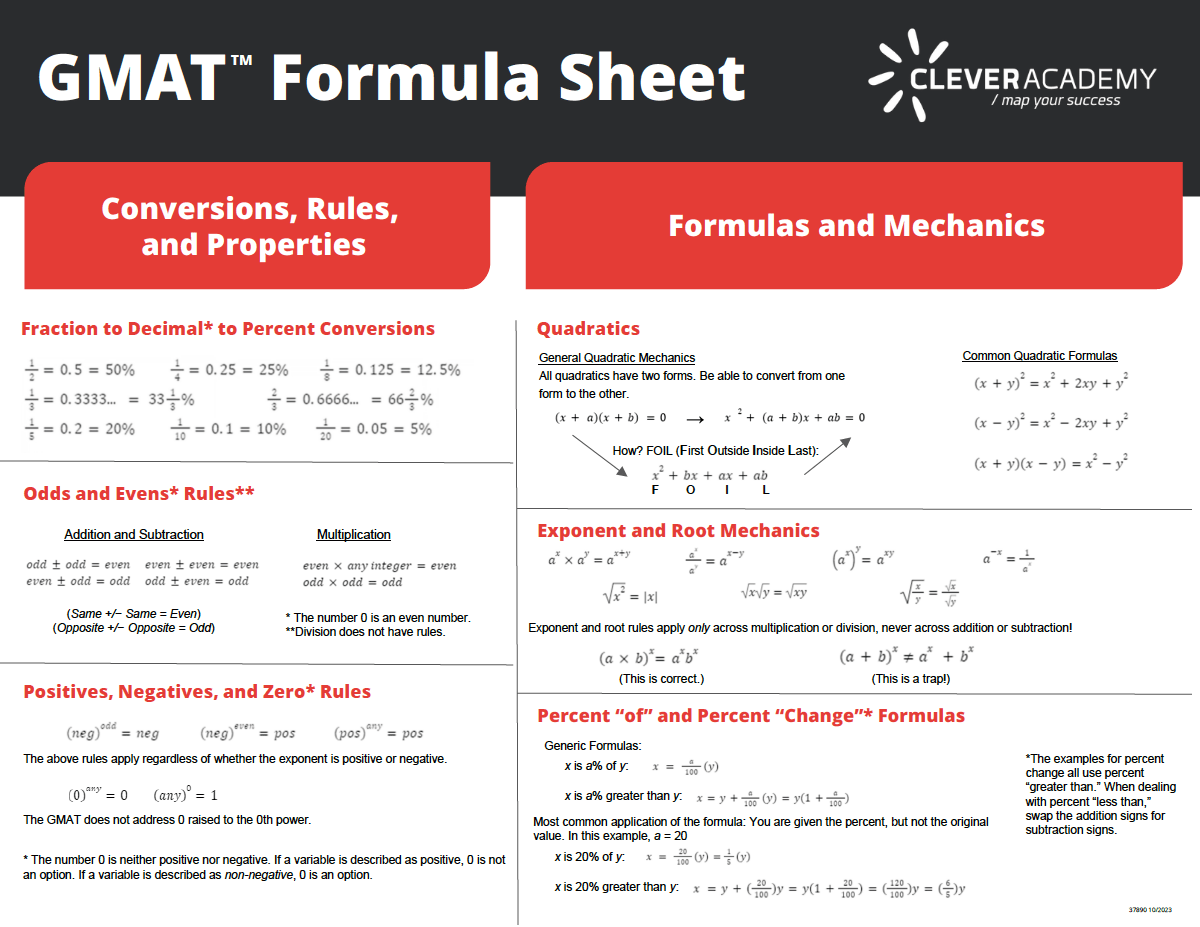
GMAT Quant Quick Sheet:
Download now the quick sheet with all the formulas!
How to train yourself to think like an executive
As you prepare for the GMAT exam, train yourself to get out of the "old-fashioned" way of thinking and move to "executive" thinking: What is the fastest and easiest way to get the answer without making mistakes?
GMAT Problem Solving Practice Question
At a particular school, 65% of students have taken language classes. Of those students, 40% have taken more than one language. If there are 300 students at the school, how many students have taken more than one language?
- (A) 78
- (B) 102
- (C) 120
- (D) 150
- (E) 195
First, read the question and write down the information provided:
- Total of 300
- 65% → LC (abbreviation for language class)
- 40% OF 65% → more than one LC
Look through the answer choices (before doing any calculations). They are fairly far apart, indicating that you can estimate at least a bit.
The first step is to figure out how many students have taken language classes. 65% is slightly less than two-thirds (or 66.7%), so use two-thirds to estimate. Two-thirds of 300 is 200, so about 200 students have taken language classes.
Is that value, 200, a slight overestimate or underestimate?
Because the actual percentage (65%) is slightly less than the percentage actually used (two-thirds or 66.7%), the value of 200 is slightly higher than any exact figure of 65%. In other words, 200 is a slight overestimate.
Next, here is the source of one of the trap answers. 40% of people who have taken more than one language class is not 40% of the total number of students. Rather, it is 40% of the 65% who have taken language classes. So the next step is to take 40% of the figure 200.
That's not a calculation that's too hard to do… but get out of your "old math" thinking. Don't calculate what you don't necessarily have to! 40% is less than 50%, so 40% of 200 must be less than 100.
Answer
The correct answer is (A). 78. Only one answer choice is less than 100.
What if the answer choices were instead the following:
- (A) 65
- (B) 78
- (C) 92
- (D) 108
- (E) 120
In that case, you could still do the first estimate (using two-thirds instead of 65%), but calculate more precisely in the second step. Here's how to do it:
- 40% of 200 is the same as 4(10%) of 200
- 10% of 200 = 20
- 4(10%) of 200 = (4)(20) = 80
80 is a slight overestimate (because you overestimated in the first step), so the correct answer in the second set of answers is the answer slightly less than 80-answer (B) 78.
To calculate percentages quickly, find benchmarks like 50%, 10%, 5%, 1% first, then multiply or add them together to get the percentage you want. For example, if you need 12%, you can find 10% and 1% then add 10% + 1% + 1%.
How to score GMAT
The GMAT Quantitative section is scored on a scale from 6 (low) to 51 (high). Most schools want to see a score of at least 40, and the most competitive schools typically look for Quantitative scores of 45 or above.
Your Quantitative, Verbal, and Data Insights scores are also combined into your Total Score, which ranges from 205 (low) to 805 (high). The Total Score is the score that schools care most about (followed by your Quantitative score, for most schools). The average GMAT score is around 545; the top 10 business school programs report average student scores ranging from 665 to 695.
Basic Information
Test Sections
- Analytical Writing Assessment (no longer in Focus version)
- Integrated Reasoning (new Data Insights)
- Quantitative
- Verbal
Helpful tips for GMAT prep
Are you ready to prepare? Sharpen your skills with these tips:
See detailed information about the GMAT prep course at Clever Academy using exclusive curriculum from the Kaplan Corporation along with world-leading instructors, as well as GMAT online prep course, study 24/7 anywhere and anytime on Vietdemy's digital education platform.