

The ACT test is emerging as a worthy alternative to the SAT. If you're considering taking the ACT or are torn between ACT or SAT, you'll definitely want to consult the ACT scoring system. That's why, in this article, let's explore the ACT scoring process and methodology with Clever Academy to help you gain a major advantage as you work toward your goals and plan your study strategy!

Overview
The ACT consists of 4 sections: English, Math, Reading, and Science. Each section is scored on a scale of 1–36. Your ACT score is the average of all 4 section scores.
The scoring scale ranges from 1–36 and is calculated based on the total number of correct answers, and incorrect answers will not be penalized (completely different from the SAT)
Converting Correct Answers to Scale Scores
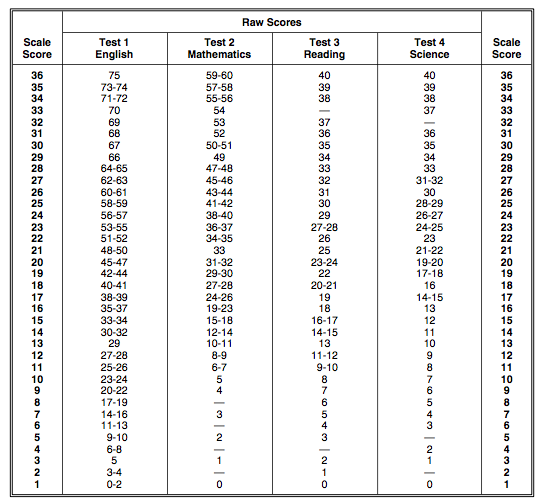
The ACT uses a conversion scale to ensure fairness for all test-takers. In other words, students taking the test at different times and on different content are still evaluated fairly and accurately.
The conversion table in the Preparing for the ACT guide allows students to estimate their own scores across each section:
How Is Your Official Score Calculated?
Your ACT score is converted from the number of correct answers using a scale of 1–36. But after all 4 sections, how is your final ACT score calculated?
Your final ACT score is simply the average of all 4 section scores, rounded to the nearest whole number.
For example, if you scored 24 in Math, 23 in Science, 26 in Reading, and 25 in English, your ACT score would be calculated as follows:
(24 + 23 + 26 + 25)/ 4 = 24.5
Rounded up, that's 25 points.
What Are Subscores?
In addition to your official ACT score based on correct answers, you'll receive subscores in Math, English, and Reading. Based on these subscores, you'll gain more insight into your strengths and weaknesses across each test section.
Unlike the main scale, subscores range from 1–18 and are also calculated based on the number of correct answers. However, it's important to note that subscores do not count toward your official ACT score. Subscores only help you identify your strengths, weaknesses, and areas that need improvement.
Should you worry about subscores? Not at all. Colleges only care about your official ACT score. In addition, they sometimes look at component ACT scores on your report. However, you should use subscores to improve your skills better for the ACT.
Differences Between Test Sections
English
On the ACT, the English section has 75 multiple-choice questions. You only earn points for correct answers; incorrect or blank answers receive no credit.
English subscores are based on 40 questions about production of writing and 35 questions about rhetorical skills.
For example, if you answer 55 questions correctly in the English section, get 15 wrong, and leave 5 blank, your score is calculated based on 55 correct answers. Using the conversion table above, you can estimate that 55 correct answers corresponds to approximately 23 points on the section score.
Math
The ACT Math section contains 60 questions total. Subscores are calculated for subsections within math: elementary algebra (24 questions), intermediate algebra (18 questions), and plane geometry (18 questions).
For example, if you answer 45 math questions correctly, get 5 wrong, and leave 10 blank, your subscore would be converted based on 45 correct answers to equal 27 points.
Reading
The Reading section consists of 40 questions. Subscores are calculated based on 20 questions covering social studies and natural science skills, and 20 questions covering reading comprehension of prose fiction and humanities.
Science
Like Reading, the Science section also has 40 questions covering data representation, research summaries, and conflicting viewpoints. However, this section does not have subscores.
Optional Writing Section
In addition to the 4 required skill sections, ACT test-takers can complete an optional writing section. Note that the writing section is an essay, not a multiple-choice test.
So how is the essay scored? And how does your writing score affect your overall ACT result?
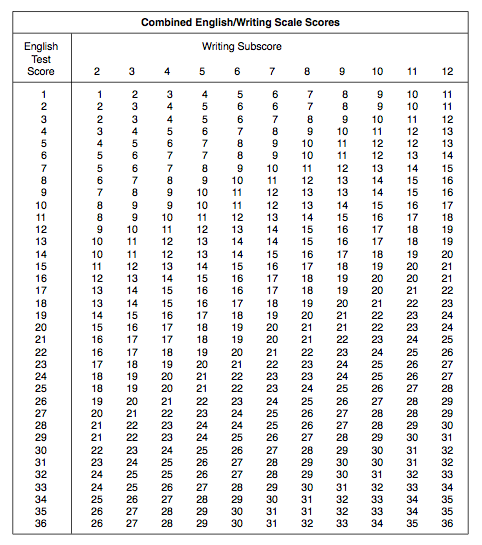
Your essay is scored by 2 raters on a scale of 1–6 each, which converts to a subscore range of 2–12. Your writing score equals the combined essay and subscore, so the highest score you can receive for the Writing section is 36 points.
Next, ACT combines your Writing score with your English and Reading scores and averages them.
Does your Writing score affect your official ACT score? The answer is no. Your official ACT score is the average of the 4 required sections. The writing section result only provides an assessment of your writing skills and does not affect your official ACT result at all.
So why take the Writing section? Some colleges explicitly require the ACT Writing section score as part of your application. You can find this information on the college's website, so be sure to check carefully before registering for the ACT.
Strategies for Achieving a High Score
Now that you understand how ACT scoring works, why not use this knowledge to develop your own strategy? Check out these top 5 tips!
Don't overly focus on skills where you're weak
Since your ACT score is calculated as the average of section scores rather than the sum, you can somewhat "overlook" the section you find challenging and focus on studying the other 3 skills. For example, suppose you're not strong in Math and your component ACT scores are:
- Reading: 30
- English: 29
- Science: 31
- Math: 22
Your ACT score would still be:
(30 + 31 + 29 + 22) / 4 = 28
See? Even though your Math score is significantly lower than your other skills, your ACT score is still 28 (top 10% worldwide).
Clever Academy especially advises you not to focus on just one skill because one section accounts for only ¼ of your ACT score. This means if you only master one section without devoting time to the other 3, your ACT score may fall short of your target.
Focus entirely on your strengths
Because your ACT score is the average of section scores, focusing solely on individual ACT skills means you're missing another important factor.
For example, you love studying English and History but don't feel interested in Math. You might tend to want to spend more time studying Math. However, devoting study time to your strongest subjects is actually the right approach for you.
Look at the 2 examples below. In the first example, you dedicate all your time to studying Math and receive component ACT scores of:
- English: 28
- Reading: 27
- Math: 25
- Science: 26
- Average score: 27
Not bad, right? Your Math score is 25 (top 20%) but your ACT score is only 27 (top 23%).
But what happens if you spend more time on your strengths like Reading and English? Look at the following component ACT scores:
- English: 33
- Reading: 32
- Math: 23
- Science: 26
- Average score: 29
So if you're not strong in Math, focus your study time on your strengths.
Number of Correct Answers
Use the conversion table to determine the minimum number of correct answers needed, then distribute your target score across each section. Once you have a clear goal, studying becomes much easier-you'll have more specific targets and clearer test-taking strategies.
For example, if you want to achieve 26 points on the ACT for each section, look it up backwards on the conversion table to find the number of correct answers needed in each section, as shown below:
- English: 60/75
- Reading: 31/40
- Math: 43/60
- Science: 30/40
Don't skip any questions
Your ACT score is not penalized for each wrong answer, so you shouldn't skip any questions. However, we don't advise you to spend all your time and effort on those impossible-to-answer questions. Instead, allocate that time and effort to other questions-questions that are likely to earn you points.
But you shouldn't skip any question either. That's when the proctor announces there's only 1 minute left before time is up-find all the unanswered questions and "guess" immediately. Remember that ACT doesn't penalize wrong answers, and of course it counts correct ones. If you guess the correct answer… well, you'll get those points!
A note about the Writing section
Although the writing section is optional on the ACT, if you take it, you'll receive a separate writing score. However, this doesn't mean your ACT study plan needs to "change direction" and dedicate all your time to studying writing. You should still stick to your original plan, focusing on the required sections and multiple-choice tests.
In reality, if your writing score is low, colleges will evaluate your writing ability by combining your test results and your transcript. So you shouldn't worry too much-just keep persisting and studying according to your established plan!
We hope that with these ACT test tips shared by our instructors at Clever Academy, you now have a more comprehensive understanding of this exam. We wish you great success and hope you'll conquer the ACT certificate excellently soon!
Clever Academy